
Masjid Bay’ah (Masjid al-Aqabah), Makkah – Travel & Historical Guide
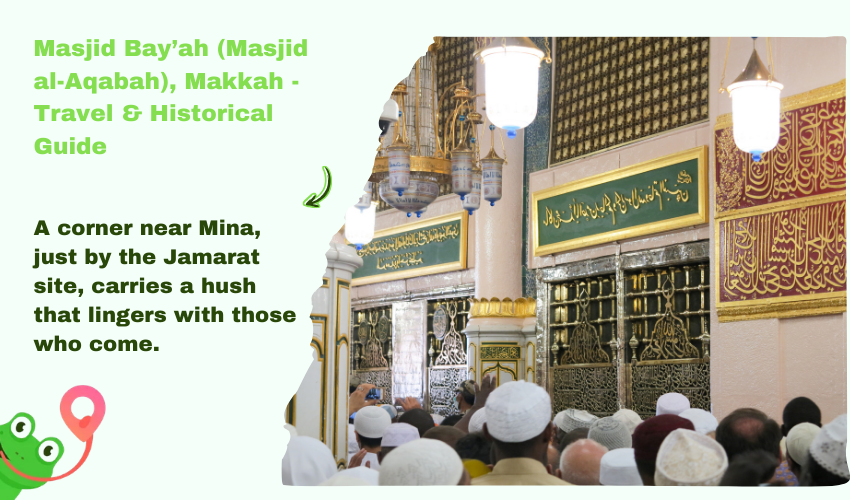
The Historic Site of the Pledges That Changed Islamic History
A corner near Mina, just by the Jamarat site, carries a hush that lingers with those who come. Known as Masjid Bay’ah – or now and then Masjid al-Aqabah – it marks where time seemed to pivot. Under wide night air in 621, oaths took shape in low but steady speech. Then again a year later, another pledge formed on the very same stretch of earth. Time folded those moments into stone now sheltered under a roof.
For pilgrims planning their ziyarat and arranging a private Umrah taxi online, Masjid Bay’ah is an essential historical stop that connects visitors directly to the early foundations of Islam.
The move followed those promises, bringing the Prophet ﷺ to Madinah, where the earliest Muslim community took shape under shared rules.
Where Is Masjid Bay’ah Located
Masjid Bay’ah is situated in:
- Mina, Makkah
- Approximately 5 to 6 km from Masjid al-Haram
- About 300 to 500 meters from Jamrat al-Aqabah
- At the base of Mount Thubayr
Down the slope from the Jamarat Bridge, heading into Makkah, it sits to the right.
From Masjid al-Haram, it takes between fifteen and twenty-five minutes to get there by vehicle, traffic deciding the exact duration.
Historical Background The Pledges of Aqabah
The First Meeting in the Eleventh Year of Prophethood
When Hajj came around, the Prophet ﷺ moved toward tribes arriving in Mina, speaking with them about Islam. Sometimes he met them early in the day, other times near dusk – each moment shaped by chance encounters. Through quiet words and steady presence, he opened paths to belief. Not force, but invitation marked his way. Moments unfolded without pressure, just clarity offered one person at a time. In that crowded valley, space was made for choice.
He came across six men from Yathrib – later called Madinah – at Aqabah. After listening to Qur’anic recitation, they embraced Islam and returned home to spread the message.
The First Pledge of Aqabah 621 CE
The following year, twelve men returned and pledged allegiance to the Prophet ﷺ.
They pledged:
- Not to associate partners with Allah
- Not to steal
- Not to commit adultery
- Not to kill their children
- Not to slander
- To obey the Prophet ﷺ in righteousness
This became known as Bay’at al-Aqabah al-Ula.
Off went Mus’ab ibn Umyar, sent by the Prophet ﷺ, heading toward Yathrib with lessons of Islam tucked into his steps. Fast on the heels of his arrival, people from Aws and Khazraj began embracing the faith, one after another.
The Second Pledge of Aqabah 622 CE
That night in Mina, under the thirteenth year of his mission, the Prophet ﷺ gathered unseen by many – seventy-three men slipped into the dark alongside two women. Their meeting took place beyond watchful eyes, quiet, deliberate, hidden from the usual paths.
With loyalty like that shown to kin, they vowed to stand by his side. Should foes arise, their backing wouldn’t waver – rooted in duty much deeper than mere oath.
There stood his uncle Abbas ibn Abd al-Muttalib, right there in that gathering.
A group of twelve people took on roles to speak for the newly formed Muslim community
- Sa’d ibn Ubadah
- Abdullah ibn Rawahah
- Ubadah ibn al-Samit
A shift in power opened paths toward Madinah, reshaping what came next for early Muslims.
Building the Mosque
Around 144 AH or 761 CE, construction began on the mosque under Abbasid ruler Abu Ja’far al-Mansur. Though centuries have passed, its foundation traces back to that era. The caliph himself oversaw early planning stages. Work took shape during his reign in Baghdad. Not long after, the structure stood complete. Its origins remain tied to al-Mansur’s rule. That moment in history set its course.
Standing tall just under a century and a half after the Prophet’s death, it rose to keep alive the echoes of those early vows.
The structure underwent renovations during the Ottoman period including restoration by Abdulmejid I.
In recent years, the Saudi government has preserved the mosque under national heritage initiatives to maintain its historical character.
Architecture of Masjid Bay’ah
Although modest in size, the mosque retains distinctive early Islamic architectural features.
Key Architectural Details
- Rectangular layout
- Approximate area between 375 and 457 square meters depending on renovation records
- Open courtyard
- Qibla wall facing southwest
- Mihrab set within a central arched recess
- Two open galleries
- Minimal decoration
- Traditional western Arabian construction style
Originally, the prayer hall had a roof supported by wooden beams and palm trunks. Today the structure stands mainly as a preserved historical monument.
Spiritual Significance of Masjid Bay’ah
Masjid Bay’ah represents:
- The unity between Muhajirun and Ansar
- The beginning of Islamic governance
- A commitment to sacrifice and protection
- The turning point that allowed Islam to flourish
Without the Pledges of Aqabah, the Hijrah may not have unfolded in the same way and Islamic history would have been very different.
For visitors, it is a place of reflection on loyalty, courage, and faith.
Visiting Masjid Bay’ah Practical Guide
Is Visiting Masjid Bay’ah Part of Hajj or Umrah
No. Visiting the mosque is not part of the rituals of Hajj or Umrah. It is a historical ziyarat site.
Best Time to Visit
- Early morning
- Late afternoon
- Outside peak Hajj days when area access may be restricted
How to Reach Masjid Bay’ah
Since Mina is not always easily walkable outside ritual days, most visitors prefer:
- Private taxi
- Guided ziyarat tour
- Hotel arranged transport
Many pilgrims who book a private Umrah taxi online include Masjid Bay’ah in a half day Makkah ziyarat tour along with other historical sites.
Frequently Asked Questions
How far is Masjid Bay’ah from Masjid al-Haram
Approximately 5 to 6 km which usually takes 15 to 25 minutes by car.
Who built Masjid Bay’ah
It was built by Abbasid Caliph Abu Ja’far al-Mansur in 761 CE.
What happened at Masjid Bay’ah
The First and Second Pledges of Aqabah took place here, leading to the migration of the Prophet ﷺ to Madinah.
Can you pray inside Masjid Bay’ah
It is sometimes open for prayer but primarily preserved as a historical landmark.
Nearby Ziyarat Places in Makkah
Pilgrims visiting Masjid Bay’ah often combine their trip with:
- Masjid al-Haram
- Cave of Hira
- Jannat al-Mu’alla
Final Reflection
A quiet presence stands where echoes of deep change once stirred. Though plain to see, its walls hold moments that bent history. That point arrived when trust took shape as a shared group life. Loyalty then meant guarding one another, not just praying together. Standing near Makkah, Masjid Bay’ah holds weight for those drawn to moments that shaped faith – here, promises were made, lives changed. Not just stone and shade, it marks where a path turned, quietly altering what came after. Commitment took shape here, not in words but actions; sacrifice followed without announcement. A shift began, steady and sure, felt long afterward across communities. This place does not shout its importance – it simply stands, holding time.
