Customer Service Revolution: Cloud Telephony’s Impact on CX

Overview
Every missed call and every minute spent on hold costs more than just patience; it’s revenue. Every person wants quick, precise, and relevant information from the support team. Most of the support teams use traditional phone systems that are limited to handle this. Investing in cloud telephony allows your teams to stay connected, routes calls intelligently, and manages interaction across channels without fail. It helps agents to satisfy customers, smoothens operations, and boosts agents’ productivity from anywhere while enhancing customer experience and engagement
Introduction
Customer experience is as important as what you’re selling or offering. Your customers are the key players to boost your revenue, and satisfaction level is pivotal. In this busy environment, they expect immediate responses, 24/7 support availability, and accurate information. But making these in place with a traditional contact center system is limited. One missed call, a long hold, or even tone variations can make them switch to a competitor.
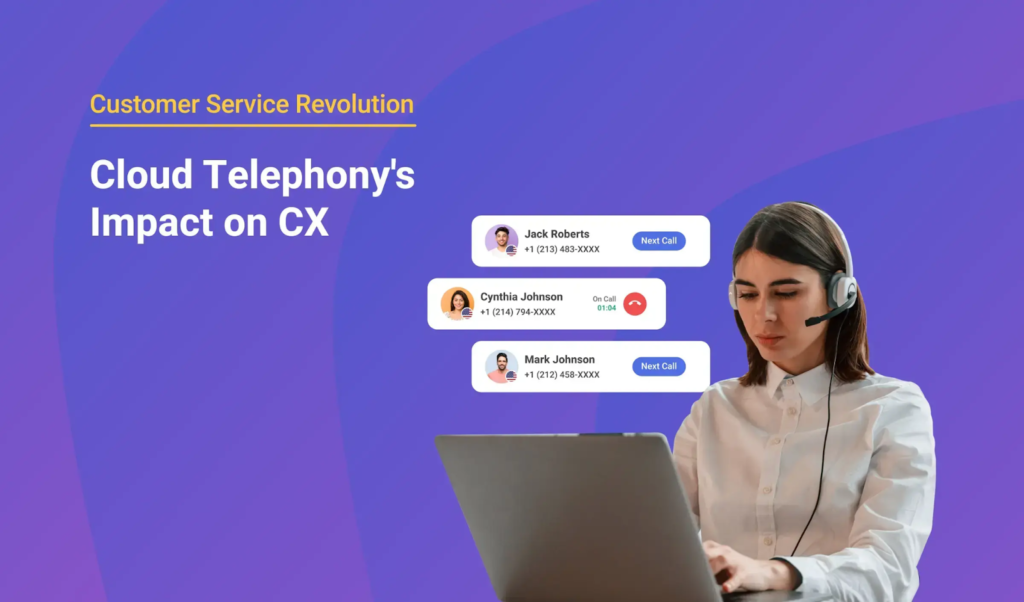
Cloud telephony resolves this by tackling problems on directing calls smartly and providing agents with relevant context for precise replies. Whether a customer starts with a chat moves to a call to tickets and emails all communications remain synchronized and transparent. It redefines customer service from a reactive process to proactive actions and values each customer. In this blog we’ll delve into how cloud telephony allows you to deliver exceptional customer service and experience.
Key Benefits of Cloud Telephony in Customer Service
Cloud telephony platforms enable your business to customize every interaction enhance agent efficiency and prioritize clients. The benefits include:
Faster Response Times
- Calls automatically reach the right agent based on preset rules.
- Agents see customer information instantly through CRM integration.
- Live dashboards, automated updates, and guidance tools eliminate bottlenecks and improve efficiency.
24/7 Availability
- Receive and send interactions from anywhere at any time on any device through secure cloud transactions.
- Self-service portals and virtual agents manage first-level queries and get escalated to the concerned agents.
- Voicemail gets automatically transcribed and sent to the respective email ID by cloud telephony.
Seamless Omnichannel Support
- From one dashboard you are able to see and handle calls, messages, chats and emails.
- Offer consistent answers by customizing standardized workflows and knowledge bases.
- Clients have the option to engage via their chosen platform while agents remain coordinated, throughout all channels.
Data-Driven Insights
- Easily track the important metrics, such as response times, first-call resolution, and agent performance, in real time.
- Analyze signals, for mood, key terms and irritation to comprehend the customers emotions.
- Link metrics to business outcomes, showing exactly how service impacts revenue.
Why Customer Service Needs Cloud Telephony Today
Customers want instant messaging, same-day resolutions, and speedy replies, whether they’re dealing with one representative or multiple. Here is how:
Never Miss a Customer
Calls may be directed smartly redirected to phones or delivered to voicemail with immediate alerts guaranteeing that every customer contact is captured.
Reduce Wait Times
With virtual queues, callback opportunities, and predicted call routing, you can get customers in contact with the right agent more quickly, meaning reduced waiting, quicker problem resolution, and improved customer satisfaction.
Impacts your ROI
You can easily map each interaction to revenue impact in terms of retention rate, upselling, or churn reduction, allowing you to track and analyze the investments.
How to solve customer service problems with cloud telephony
Problem 1: After-Hours Calls Go Unanswered
A customer calls late at night and nobody answers. They hang up and might never return.
Solution using cloud telephony:
- Calls can be routed to an on-call agent’s number.
- Voicemails are converted to emails or SMS notifications so nothing falls through.
- IVR menus (press 1 for… press 2 for…) direct customers to speedy answers or self-service.
Problem 2: Inconsistent Experience Across Channels
A customer starts with chat then ends the session and phones in yet the new agent is unaware of the earlier discussion. The customer has to begin.
Solution using cloud telephony:
- Every form of communication (calls, texts, emails, chats) is stored within one customer profile.
- Representatives have access, to the full record of the conversation.
Problem 3: Long Wait Times
A customer calls, is placed on hold for 20 minutes, becomes angry, and hangs up.
Solution using cloud telephony:
- Smart routing ensures calls reach the right person more quickly.
- Virtual queues allow customers to hold their spot and offer immediate call back.
- Immediately allocate resources based on call volumes and alerts.
Problem 4: No Clear Way to Measure Performance
Managers are unaware of the number of missed calls, the duration customers spend waiting, or which agents perform best. You cannot improve what you do not track.
Solution using cloud telephony:
- Consolidated dashboards display metrics including waiting time, call resolution percentage, and agent efficiency.
- Data connects customer interactions with business results, such as repeat sales or decreased churn.
How to Choose the Right Cloud Telephony Solution
Choosing the right solution varies with your organization’s requirements, size, and model. Here’s a list of factors you should consider while implementing one for your business.
Core Capabilities: Look for smart call distribution, personalization, sophisticated IVR Service, live analytics, and a seamless omnichannel interface.
Security: Guarantees of uptime, protected cloud storage, worldwide reach, top-tier security, and regulatory compliance.
Intuitive Dashboard: Choose a system that’s easy to use, quick to understand and requires minimal technical knowledge or training.
Effortless Integration: The solution must link seamlessly with your CRM, helpdesk and other platforms.
Scalability and Flexibility: Select a system that expands alongside your business; whether launching a branch or incorporating an agent it should be able to scale.
Conclusion
Customer service involves people feeling heard, understood, and supported. Conventional phone systems frequently cause calls and long waiting times. Having to explain things multiple times, which leads to customer dissatisfaction.
However, cloud telephony made this easy with intelligence, automation, and integrations. But keep in mind that not every cloud telephony solution is the same. Selecting the one that is easy to use, secure and adaptable, to your business needs is what really counts. Beyond managing calls the platform enables you to create experiences that build trust and promote customer loyalty.
Key Takeaways
- Modern consumers demand uninterrupted and round-the-clock service across all platforms.
- Cloud telephony allows companies to always catch every call or message regardless of the time or communication platform.
- It reduces annoyance by removing delays and equipping agents with the customer background.
- Immediate data enables service teams to operate effectively and anticipate issues.
Selecting the right solution involves prioritizing scalability, security, integration, and simplicity.