
5 Strategies for Productive Studying on the Road
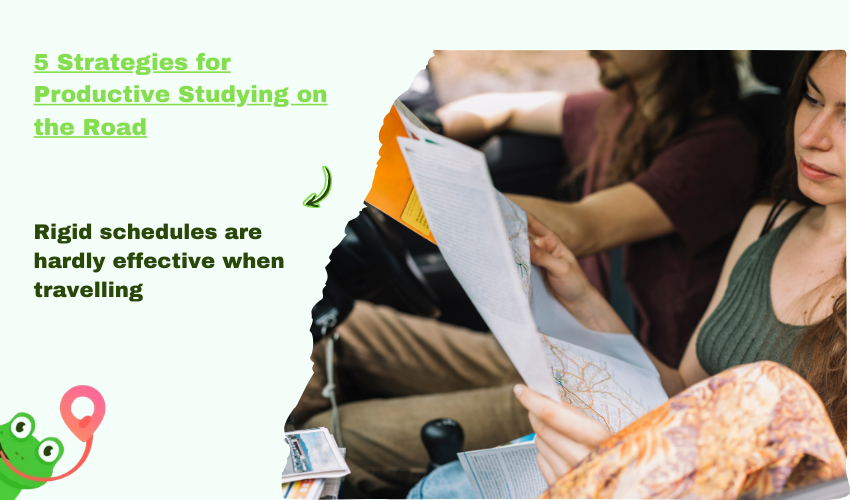
One of the most enriching and thrilling experiences can be traveling when you are still a student. New destinations also introduce new outlooks, culture, and ideas which have the potential to impact positively on personal growth as well as academic growth. Nevertheless, it is not always a simple matter to balance between traveling and university. Amid sightseeing, transportation, and socialization, it is hard to stick to the coursework, research projects, and writing of academic work.
As a student fond of the idea of studying the world with the help of traveling platforms such as TripFrog, it is necessary to know how to study on the road. Rather than perceiving travel as a form of distraction to their studies, students may use it as a tool to improve their time management, self-discipline and creativity.
The following are five effective tips that would help the students to be productive academically but also to enjoy their traveling experiences.
1. Establish a Versatile Study schedule.
Rigid schedules are hardly effective when travelling. The experience involves delays, spontaneous plans and finding out things that were not supposed to be learned. The students need not develop a rigorous schedule but develop a flexible study schedule that will fit their traveling schedule.
As an example, you may spend some time studying in the most silent times of the day, such as early mornings in a hotel room or evenings after a day of discovering the city. Less time but intensive analysis is usually better than attempting to execute big tasks simultaneously.
Routine (even basic) everyday life will ensure the academic stasis and so the assignments will not accumulate in the trip.
2. Stay in touch with your studies using Technology.
With technology, students have found it very easy to keep on learning even when they are traveling. Online learning platforms, cloud storage services and online libraries enable learners to access course materials almost anywhere in the world.
The notes of the lectures, the articles of research, and the necessary reading materials can be downloaded prior to a trip in order to have them even in the absence of the Internet connection. Academic writing can also be completed with writing aids, citation managers as well as grammar-checking applications that can support writing on the move.
The use of productivity apps to combine tasks, deadlines, and progress of study is also beneficial to many students. These tools are used to make sure that important assignments are not overlooked during exploration of new destinations.
Simultaneously, students may also seek further academic assistance via the internet when their time schedules are too tight. It is not unusual for students who have time limits in visits to find essay writers for hire or other reasons that enable them to keep up with their performance. Stress can be minimized by means of having good academic support, which will allow one to travel and study easily.
3. Select Study-Favoring Environment.
Productivity and concentration may also be greatly influenced by the surroundings. During the trip, students should attempt to locate locations that facilitate focused work.
The activities can be done in quiet cafes, hotel lounges, libraries, or co-working spaces which usually offer comfortable conditions to read, write, or study course materials. There are even some travelers who study in the parks or other scenic places and that way schoolwork seems much less stressful and pleasant.
It is important to get a location where you can work without distraction. One hour of studying in a quiet room is sufficient to achieve significant advancement on a task.
4. Make Travel Experiences Learning Experiences.
Travelling obviously opens students to new ideas and views which may be very useful in academic work. Students do not need to divide travel and education, but can combine both in their studies.
The example is that going to historical places, museums or cultural events may give essay and research paper ideas. Looking at the local culture or society can be interesting in general, and it can be a topic of study in sociology, anthropology, or international relations.
Observers of travel experiences can also use their notes in academic writing. The notes made when a trip is made about observations, thoughts and questions can be used afterwards to aid students in making better or original arguments in their course work.
Travel, in most aspects, makes the world to be an even bigger classroom where learning opportunities extend well beyond lecture rooms.
5. Value Well-Being and Time Management.
Efficient road studying requires not only discipline, but also personal well-being. Travel may be physical, and this is more so when the students attempt to cover numerous locations in a less time frame.
Academic activities become manageable when students are active and balanced.
Travel activities can also be planned in a realistic manner. Attempting to cover it all in a day will make one exhausted and may have little time to study. The moderation between exploration and study time will result in a more fun and productive trip.
Final Thoughts
Travel and education do not necessarily need to compete. Actually, they are capable of complementing each other in such a forceful manner. Students that learn to study properly during traveling tend to become more independent, creative and also develop better skills in solving problems.
A flexible schedule, the appropriate range of digital tools, and a balanced schedule allow staying academically productive and discovering new destinations. Travel has the potential to spark new ideas, enhance writing and offer useful real world experiences that enrich the learning in academics.
To the students who access the services of TripFrog to explore some of the most interesting places to visit, any trip can be more than a holiday. It is either a chance to study, develop and make the whole world a discovery, both in academic and personal sense.
